



The greatest single opportunity to drive lasting employee engagement and maximise your wellbeing ROI in 2026 isn’t a complex new policy; it’s already on your calendar. It starts in January. For employers and HR leaders, the start of the year offers more than just a calendar reset; it presents a critical window of opportunity to drive significant, lasting employee engagement. This is the essence of ‘The January Effect’: the annual surge in motivation that, when strategically supported, can transform a short-term perk into a core tool for talent retention and business resilience.
Latest research by leaders in the employee fitness benefits space, Hussle, investigates this phenomenon using new survey data to reveal what truly motivates employees to get active in the new year and what crucial barriers employers must remove to maximise their investment.
The new primary driver: mental wellbeing
The notion that January activity is simply about weight loss is outdated. New data shows that the pursuit of health is now deeply tied to mental resilience, a vital concern for a workforce facing a resilience crisis.
In Hussle’s latest survey of 3500+ respondents, they asked employees for their main reason for using the gym during the winter months, and the results were striking: the main motivator is ‘mental health,’ with 38% of all respondents citing this factor. This finding highlights that the New Year’s focus is driven by the desire for improved mental wellbeing, a priority that is now clearly higher in winter compared to previous research.
This is directly relevant to the current corporate landscape, where stress, depression, and anxiety account for the majority of days lost due to work-related ill health in the UK. By launching a high-value fitness benefit in January, employers are implementing a preventative tool at the precise moment employees are most receptive to engaging with their fitness goals, thereby maximising initial engagement, reinforcing a supportive culture, and reducing stress-related absenteeism.
Why January is the critical window for launch
The timing of your benefit launch is paramount to its long-term success. January is not just a market trend; it is a period of genuine, active commitment that aligns perfectly with both individual aspirations and the corporate calendar.
Our recent survey confirms this motivational peak: Overall, we are most motivated to go to the gym in January, with 22.6% of respondents indicating this as the most important month for them. This individual motivation is mirrored in industry data: according to UK Active, fitness venues across the UK are 28% busier in January than in December, and 10% busier than in the combined autumn months. This demonstrates that employees are actively seeking fitness solutions at this precise moment.
The January motivation surge is not a temporary change; it is the start of a long-term commitment for millions. If you can successfully capture and support this initial desire, the rewards are significant. Data from the fitness industry reveals that a full 50% of new members who join in January are still active 6 months later. This 50% long-term adoption rate is significant for any employee benefit and provides a strong foundation for year-round engagement. By launching in January, you align your investment with this natural employee commitment, ensuring your wellbeing budget delivers maximum ROI.
Internal Hussle data corroborates this spike: in January 2025, they saw a 46% increase in new monthly members compared to the overall 2024 monthly average. They also saw a 21% increase in gym visits when making the same comparison.
Aligning with the strategic HR calendar
Beyond individual motivation, January represents a strategic advantage for HR leaders. The start of the year typically signals the renewal of benefit programmes and the establishment of new corporate budgets and goals. This provides a clean slate for communication and adoption:
- Financial Alignment: Launching in January allows HR and Finance teams to integrate the benefit into the new fiscal year budget from the outset, streamlining planning and capital efficiency.
- Recruitment Advantage: January sees a significant “rebound” in recruitment activity. By offering a high-value wellbeing benefit when the market is competitive, you strengthen your total rewards offering and improve your ability to attract and retain top talent.
By launching a high-value fitness benefit in January, employers are implementing a powerful preventative tool at the time employees’ commitment and fitness goals are organically aligned, maximising initial engagement, reducing stress-related absenteeism, and reinforcing a supportive culture.
Understanding and removing the barriers
50% of new members who join a fitness venue in January are still active six months later. For these individuals, the desire for better health is genuine and long-lasting.
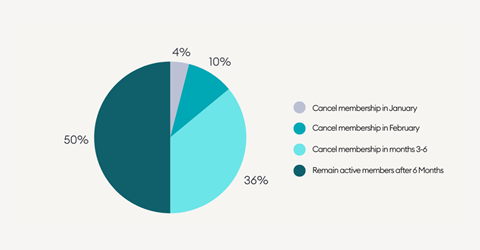
However, as you can see in the data from Sports Insight, many do not persevere with their newfound fitness goals. For the 50% of new joiners who drop off, the failure is often not a lack of interest but rigid benefit structures and financial barriers. The cost barrier is particularly acute during the New Year period, as we’ve also learned from Hussle’s recently conducted survey:
- Financial Squeeze: 27.4% of respondents say December clearly poses the most significant financial challenge, followed closely by January (16.35%).
- Targeted Support: This squeeze is particularly challenging for certain demographics; for instance, the 61+ demographic felt the January challenge most significantly, with 26% reporting this as their most financially restrictive month.
By offering a flexible, subsidised multi-venue benefit like Hussle, employers directly reduce the cost and rigidity obstacles that cause employees to quit. This intervention ensures that the mental and physical motivation employees feel in January is supported and sustained year-round.
The time to act is now
The data is clear: January is the moment when employees are most receptive to a high-impact wellbeing solution. You have a critical opportunity to capture this motivation, deliver a tangible benefit, and ultimately reduce costly absenteeism. Investing in workplace health initiatives has been shown to deliver a strong economic return.
Are you doing all you can to support your employees in getting more active?
Download the full report:
To access more survey results and a detailed strategy for leveraging ‘The January Effect’ to drive employee productivity and culture change, download the full ‘The January Effect’ report.
Related Companies
- Previous
- Next